




Quick answer: ITAD (IT Asset Disposition) is the secure, documented process of retiring end-of-life IT equipment. It covers asset inventory, data sanitization, reuse, resale, recycling and reporting, so businesses protect data, recover value from old hardware and meet compliance and environmental obligations.
Picture a company with 200 laptops to retire before an office move. Each one holds saved passwords, client files and employee records. Leaving them in a storage closet, or handing them to a general recycler, leaves that data exposed.
That is the problem ITAD solves. A documented ITAD process takes hardware from the moment it is retired through data sanitization, reuse, resale or recycling, and then proves what happened to every device.
What Is ITAD?
ITAD stands for IT Asset Disposition, which refers to the management of computer systems, servers and other assets after they are no longer required in a business. It's more than just dumping old electronics in a bin.
Depending on the value that can be still be added to the devices, they can be reused, refurbished, resold, recycled, or disposed of in a secure manner in a real ITAD process.
For example, 100 laptops can be retired from a company, but not all of those 100 laptops will take the same route. Some are still functioning and are cleaned and re-used.
Others are refurbished and sold. The rest, most oldest or damaged units are sent to certified recyclers. It is this combination of results what is ITAD in practice, a collection of asset disposition decisions and not one.
Why Is ITAD Important for Businesses?
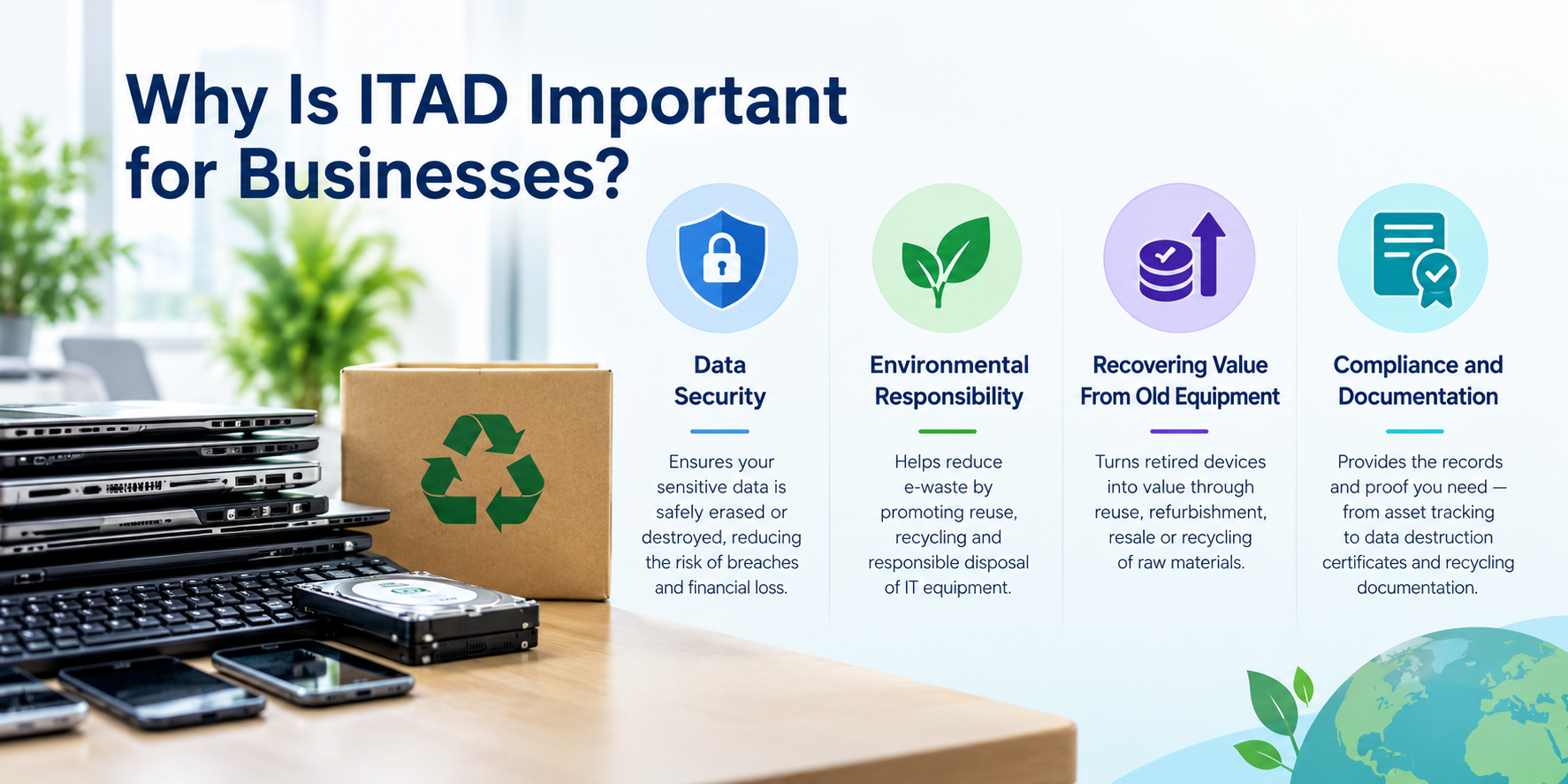
Now that you know something about what is ITAD as basic, the following question is, why do businesses use ITAD instead of simply discarding old hardware for four reasons: data security, environmental responsibility, value recovery and compliance.
Data Security
Retired devices can hold saved logins, cached files and entire customer databases. Deleting a file does not remove it from a drive, and it can often be recovered. The financial exposure is real.
According to IBM's 2026 Cost of a Data Breach Report puts the global average cost of a breach at USD 4.99 million, and it took organizations an average of 247 days to identify and contain one.
Accurate ITAD is based on verified sanitization processes, such as:
- Secure data erasure that overwrites storage completely
- Data Degaussing, which uses magnetic fields to erase data on certain drive types
- Physical destruction, for drives that cannot or should not be reused
The correct method depends on the device, its sensitivity and the policies of the organization.
Environmental Responsibility
Electronic waste is one of the most rapidly growing streams of waste globally. According to the report of "Global E-waste Monitor 2024" published by the ITU and UNITAR, in 2022, the amount of generated e-waste reached 62 billion kg, while 22.3% was reported to be officially collected and recycled.
Responsible ITAD recycling and reuse helps to prevent that waste stream from containing usable equipment.
Recovering Value From Old Equipment
Retired IT Equipment does not have to be worthless. A device can be used again, repaired, refurbished, sold, disassembled for parts, or recycled for raw materials based on the condition.
That is why "disposition" is a larger concept than "disposal. Disposal means that it is no longer usable. Disposition is when someone judges the value of what it is after.
Compliance and Documentation
Many organizations require evidence of what's happened with their retired IT assets, if it is carefully "taken care of”. This usually means asset tracking, chain of custody, data destruction records, certificates of destruction and recycling documentation.
Requirements may differ from region to region and industry to industry, so check to see if they apply to your particular case.
How Does the ITAD Process Work?
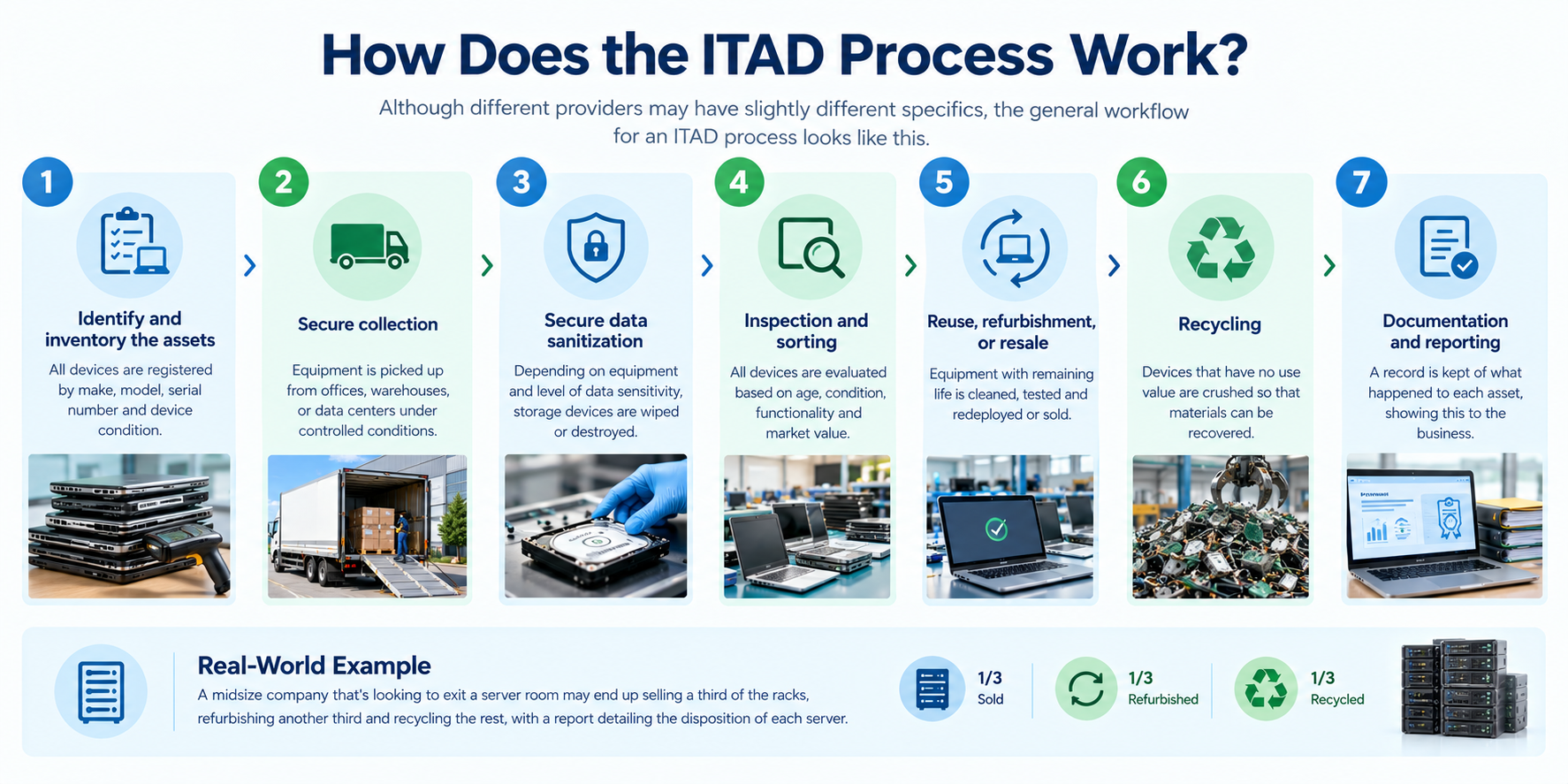
Although different providers may have slightly different specifics, the general workflow for an ITAD process looks like this.
1. Identify and inventory the assets: All devices are registered by make, model, serial number and device condition.
2. Secure collection: Equipment is picked up from offices, warehouses, or data centers under controlled conditions.
3. Secure data sanitization: Depending on equipment and level of data sensitivity, storage devices are wiped or destroyed.
4. Inspection and sorting: All devices are evaluated based on age, condition, functionality and market value.
5. Reuse, refurbishment, or resale: Equipment with remaining life is cleaned, tested and redeployed or sold.
6. Recycling: Devices that have no use value are crushed so that materials can be recovered.
7. Documentation and reporting: A record is kept of what happened to each asset, showing this to the business.
A midsize company that's looking to exit a server room may end up selling a third of the racks, refurbishing another third and recycling the rest, with a report detailing the disposition of each server.
What Happens to IT Equipment After Disposition?
|
Equipment condition |
Possible outcome |
|
Fully functional |
Reuse or resale |
|
Minor faults |
Repair or refurbishment |
|
Outdated but valuable components |
Parts recovery |
|
No practical reuse value |
Responsible recycling |
|
Storage device requiring high-security treatment |
Secure destruction |
It depends upon the condition of the device, the sensitive nature of its data, and compliance issues within the industry or geographical location.
ITAD vs. IT Recycling: What Is the Difference?
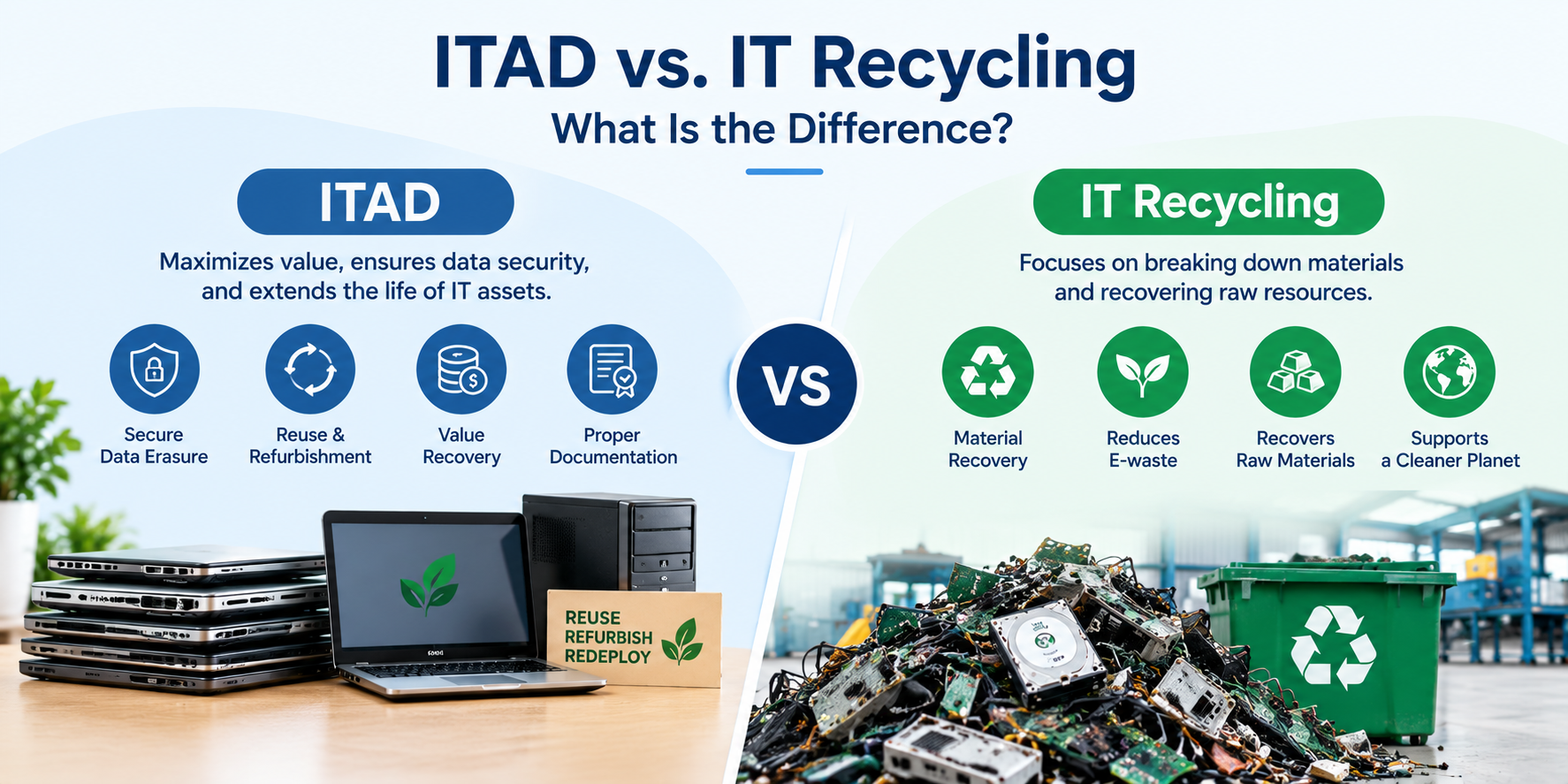
There is a lot of confusion about what it means for something to be ITAD versus IT recycling, but it is not the same.
ITAD is the full lifecycle which includes inventory, data sanitization, reuse, resale, and disposition. IT recycling is one possible result of that process, which involves physically breaking the equipment and extracting materials that no longer can be used.
|
Aspect |
ITAD |
IT Recycling |
|
Scope |
Full lifecycle management of a retired asset |
One stage within that lifecycle |
|
Includes |
Inventory, data sanitization, reuse, resale, refurbishment, disposition |
Physical breakdown and material recovery |
|
Goal |
Decide the best possible outcome for each device |
Recover usable raw materials from equipment with no reuse value |
|
Data Removal |
Official deletion or destruction |
No guarantee of removal unless sanitization happens at this stage |
|
Risk |
Eliminated |
High |
|
When it applies |
Every retired IT asset, starting at pickup |
Only equipment that cannot reasonably be reused, resold, or refurbished |
In short, it's not recycling, it's a stop on the ITAD road.
What Does an ITAD Provider Do?
An ITAD provider is responsible for some or all of the following: asset collection, asset inventory, data sanitization, data verification, equipment testing, equipment grading, refurbishment, sale of assets, recycling, reporting and compliance documentation, and logistics coordination.
Not all providers have all services available. Some ITAD providers can take care of the whole process and others can specialize in one stage and work with others in the remaining stages.
Why Logistics Matters in ITAD
The actual work of ITAD doesn't finish when the equipment departs the building. However, some resources have to move from one office to another office, from one data center to one processing center, from one recycler to one refurbisher, and even from one refurbisher to one buyer based in a different continent.
Each of those movements are risky. If a pallet of unwiped drives spends a night in a truck, it is a data security issue, not just a shipping delay.
Logistics for ITAD needs to consider secure pick up, secure packaging, chain of custody documentation, customs requirements, in-transit tracking and delivery timelines that are in sync with the rest of the plan.
This is the part of ITAD that Sky2C focuses on. Sky2C offers logistics solutions to ITAD companies and refurbished IT equipment, such as secure onsite pickup, white-glove packaging, documentation and compliance management, air and LTL shipping worldwide and tracking status updates in real time to customers.
It can be used with refurbished laptops, desktops, monitors, servers, racks, data center hardware, and POS terminals.
Sky2C is the no.1 ITAD logistics provider in the United States. A provider manages the asset's lifecycle: sanitization, refurbishment, resale, recycling. A logistics partner such as Sky2C carries the physical asset from one point to another which ensures security.
How to Choose an ITAD Company
Once you understand what ITAD is and how it operates, choosing an ITAD provider will be easier. It can be difficult to find the right way to compare itad companies if you don't have a structure in place.
Data Security Practices
Request a specific explanation on how the provider sanitizes data, and if they have documentation to prove it.
Asset Tracking
Verify tracking of equipment from pick up to the final outcome, not only at drop off.
Certifications and Standards
Certifications can indicate a process has been set in place, but verify which ones apply to the services and area involved.
Recycling and Sustainability Practices
Ask about the location of equipment and the treatment of recyclable materials.
Reporting
Be sure to check for asset level reporting and, if possible, certificates of destruction.
Logistics Capability
If equipment crosses state or country lines, check with the provider or its logistics partner, if they can manage international delivery and customs requirements.
Many businesses tend to research this same way: looking for itad companies near me, visiting a list of the best itad companies, or search results such as itad companies uk or itad companies usa.
While a detailed itad companies list is a great place to start, be sure to consider it as a short list rather than the top-ranked list to trust.
ITAD for Different Business Situations
ITAD is used in more situations than you might think:
- Office relocation
- Data center decommissioning
- Hardware refresh cycles
- Mergers and acquisitions
- Business closures
- Lease returns
- Global IT equipment redistribution
Common ITAD Mistakes Businesses Should Avoid
- Treating ITAD like ordinary trash: Skips data security and value recovery.
- Assuming deleted files are gone: Verified sanitization is a separate step.
- Losing track of assets: Without inventory, no one can say where a device ended up.
- Ignoring chain of custody: Gaps are exactly where data risk happens.
- Choosing on price alone: Cheap quotes sometimes skip documentation or certified recycling.
- Don't forget international shipping rules: Customs is not a requirement in domestic moves but it is in cross-border moves.
- Skipping disposition records: If no records are available there is no proof of what happened.
Conclusion
The term ITAD does not only refer to disposal of old computers. ITAD refers to responsible management of retiring technology by ensuring protection of data, asset recovery, reducing unnecessary e-waste, and keeping track of all ITAD actions that have been performed to all equipment. This is what ITAD actually means – a process, not an action.
If an organization has to move its ITAD assets between one location to another or cross the borders, logistics becomes a very real aspect of this process. Need to move your refurbished IT assets or ITAD assets across the borders? Explore Sky2C's ITAD logistics solutions.
FAQ's(Frequently Asked Questions)
Q1 . What Does ITAD Mean?
ITAD meaning, the structured process of managing retired IT equipment, including data sanitization, reuse, resale, recycling, and disposal, through to a documented outcome.
Q2 . What Is IT Asset Disposition?
IT Asset Disposition is the full form of ITAD, the process businesses use to responsibly retire computers, servers, and other equipment once they are no longer needed.
Q3 . Is ITAD the Same as IT Recycling?
No, IT recycling is one possible outcome inside the ITAD process, used for equipment that cannot reasonably be reused or resold.
Q4 . What Equipment Can Go Through ITAD?
Laptops, desktops, monitors, servers, networking gear, mobile devices, and storage hardware are all common candidates for ITAD.
Q5 . How Does ITAD Protect Company Data?
Through verified sanitization: secure erasure, degaussing, or physical destruction, matched to the device and its sensitivity.
Q6 . Can Businesses Recover Money From Old IT Equipment?
Sometimes. Equipment in good condition can often be resold or refurbished, offsetting some disposition cost.
Q7 . Does ITAD Include Transportation and Logistics?
Yes. Assets almost always need to move somewhere, and some providers handle logistics directly while others rely on logistics partners.


