




In freight shipping, Incoterms matter more than many shippers realize. When cargo moves across borders, the chosen trade term decides who arranges transport, who pays for insurance, who handles customs responsibilities, and where risk transfers from seller to buyer.
Since air and ocean freight operate differently, not every Incoterm works the same way for both modes.
For importers, exporters, and logistics teams, choosing the wrong term can lead to avoidable charges, insurance gaps, confusion over responsibility, and disputes at destination.
Understanding which international commercial terms apply to air shipments and which are restricted to ocean transport is essential for cleaner contracts and smoother execution.
Why Incoterms matter by transport mode
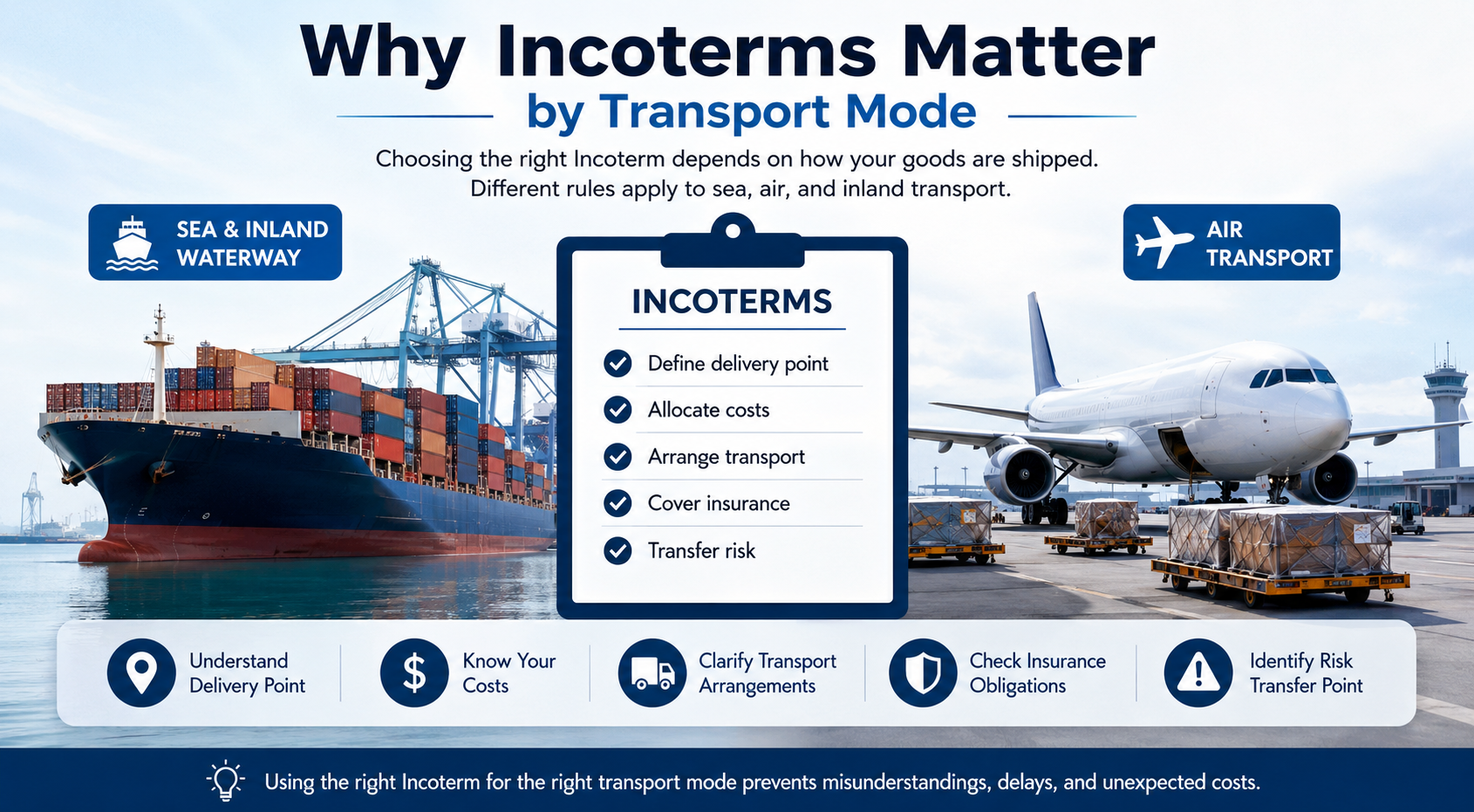
Incoterms are globally recognized trade rules published by the International Chamber of Commerce.
They clarify the responsibilities of buyers and sellers in an international sales contract, including delivery point, cost allocation, transport arrangement, insurance obligations, and risk transfer.
Transport mode matters because some rules are written for any mode or modes of transport, while others are designed only for sea and inland waterway movements.
This is where many shippers make errors.
Terms like FOB or CIF are often used too casually, even in situations where containerized or air cargo would be better covered under FCA, CPT, or CIP.
In practical terms, if goods are handed over to an airline, cargo terminal, or freight forwarder rather than placed directly on board a vessel, sea-only rules may not be appropriate.
That distinction is especially important when comparing incoterms for air freight with incoterms for sea shipment.
The 11 Incoterms used across air and ocean freight
Seven Incoterms can be used for any mode of transport, including air, ocean, road, rail, or multimodal shipments.
These are usually the most relevant rules for modern containerized cargo and air freight operations.
The 7 air-only Incoterms
1 . EXW – Ex Works
- Under EXW, the seller makes the goods available at its premises or another named place. The buyer takes on nearly all transport responsibilities, export arrangements, and risks from that point onward.
- This can appear simple, but EXW often creates operational complications in cross-border trade because the buyer may not be best placed to manage export formalities in the seller’s country.
2 . FCA – Free Carrier
- FCA means the seller delivers the goods to the buyer’s nominated carrier at a named place. Risk transfers once the goods are handed over there.
- FCA is widely regarded as one of the best incoterms for air freight, because air cargo is typically delivered to a carrier or terminal rather than loaded “on board” in the maritime sense. It is also highly suitable for containerized ocean cargo.
3 . CPT – Carriage Paid To
- With CPT, the seller pays for carriage to a named destination, but risk transfers to the buyer once the goods are handed over to the first carrier.
- This is useful when the seller can secure transport efficiently but the buyer accepts risk during transit. It is one answer to the question, what incoterms are used for air freight, especially in scheduled commercial cargo movements.
4 . CIP – Carriage and Insurance Paid To
- CIP works like CPT, but the seller also arranges insurance. Risk still transfers when the goods are given to the first carrier, even though the seller pays carriage and insurance to destination.
- For higher-value or sensitive cargo, CIP can be an excellent fit in air logistics. It is often considered among the best incoterms for air freight when the buyer wants a clearer insurance layer built into the shipment arrangement.
5 . DAP – Delivered at Place
- Under DAP, the seller is responsible for delivering the goods to the named place at destination, ready for unloading. The buyer handles import clearance and duties.
- This is useful when sellers want to offer a near door-delivery structure without taking on import tax responsibility. It works well in both air and ocean freight depending on shipment design.
6 . DPU – Delivered at Place Unloaded
- DPU means the seller delivers and unloads the goods at the named destination. This is the only Incoterm where the seller is responsible for unloading.
- It can be useful for project cargo or structured destination delivery, but the named place must be chosen carefully because unloading responsibility changes cost and operational risk.
7 . DDP – Delivered Duty Paid
- DDP places the maximum obligation on the seller. The seller delivers the goods to the named destination and also bears import duties, taxes, and clearance responsibility.
- While attractive from a buyer perspective, DDP can be risky for sellers if they are unfamiliar with destination-country regulations or customs structures.
The 4 sea-only Incoterms
Four Incoterms apply only to sea and inland waterway transport. These are part of the classic ocean freight terms framework, but they should not be used for air freight.
1 . FAS – Free Alongside Ship
- The seller places the goods alongside the vessel at the port of shipment. From that point, the buyer assumes cost and risk.
- FAS is typically used for bulk or non-containerized cargo rather than standard air or parcelized freight.
2 . FOB – Free On Board
- Under FOB, the seller delivers the goods on board the vessel at the named port of shipment. Risk transfers once loading onto the vessel is complete.
- FOB remains one of the most commonly discussed sea freight terms, but it is not recommended for air freight and is often misused even in container shipping, where FCA may be more accurate.
3 . CFR – Cost and Freight
- With CFR, the seller pays the cost and freight to the destination port, but risk transfers once the goods are loaded on board the vessel at origin.
- This rule belongs to maritime shipping only and is unsuitable for air cargo. It is also less suitable for certain containerized shipments if operational control is not clearly aligned.
4 . CIF – Cost, Insurance and Freight
- CIF is similar to CFR, but the seller also arranges marine insurance. Risk still transfers once goods are loaded at origin, even though carriage and insurance are paid to destination.
- CIF remains common in traditional marine trade, especially bulk commodities, but it is not an air freight rule. This is one of the clearest dividing lines between incoterms for air freight and incoterms for sea shipment.
Air freight vs ocean freight Incoterms
Here is a direct comparison of which rules fit which transport mode.
|
Incoterm |
Applies to Air Freight |
Applies to Ocean Freight |
Key point |
|
EXW |
Yes |
Yes |
Buyer takes on most obligations early. |
|
FCA |
Yes |
Yes |
Strong choice for air and containerized freight. |
|
CPT |
Yes |
Yes |
Seller pays carriage, buyer takes transit risk after handover. |
|
CIP |
Yes |
Yes |
Includes seller-arranged insurance. |
|
DAP |
Yes |
Yes |
Seller delivers to named place, buyer clears imports. |
|
DPU |
Yes |
Yes |
Seller delivers and unloads at destination. |
|
DDP |
Yes |
Yes |
Seller handles nearly everything, including duties. |
|
FAS |
No |
Yes |
Maritime and inland waterway only. |
|
FOB |
No |
Yes |
Vessel-loading term, often misused outside sea freight. |
|
CFR |
No |
Yes |
Ocean-only, seller pays freight to destination port. |
|
CIF |
No |
Yes |
Ocean-only, includes seller-arranged marine insurance. |
How to choose the right Incoterm
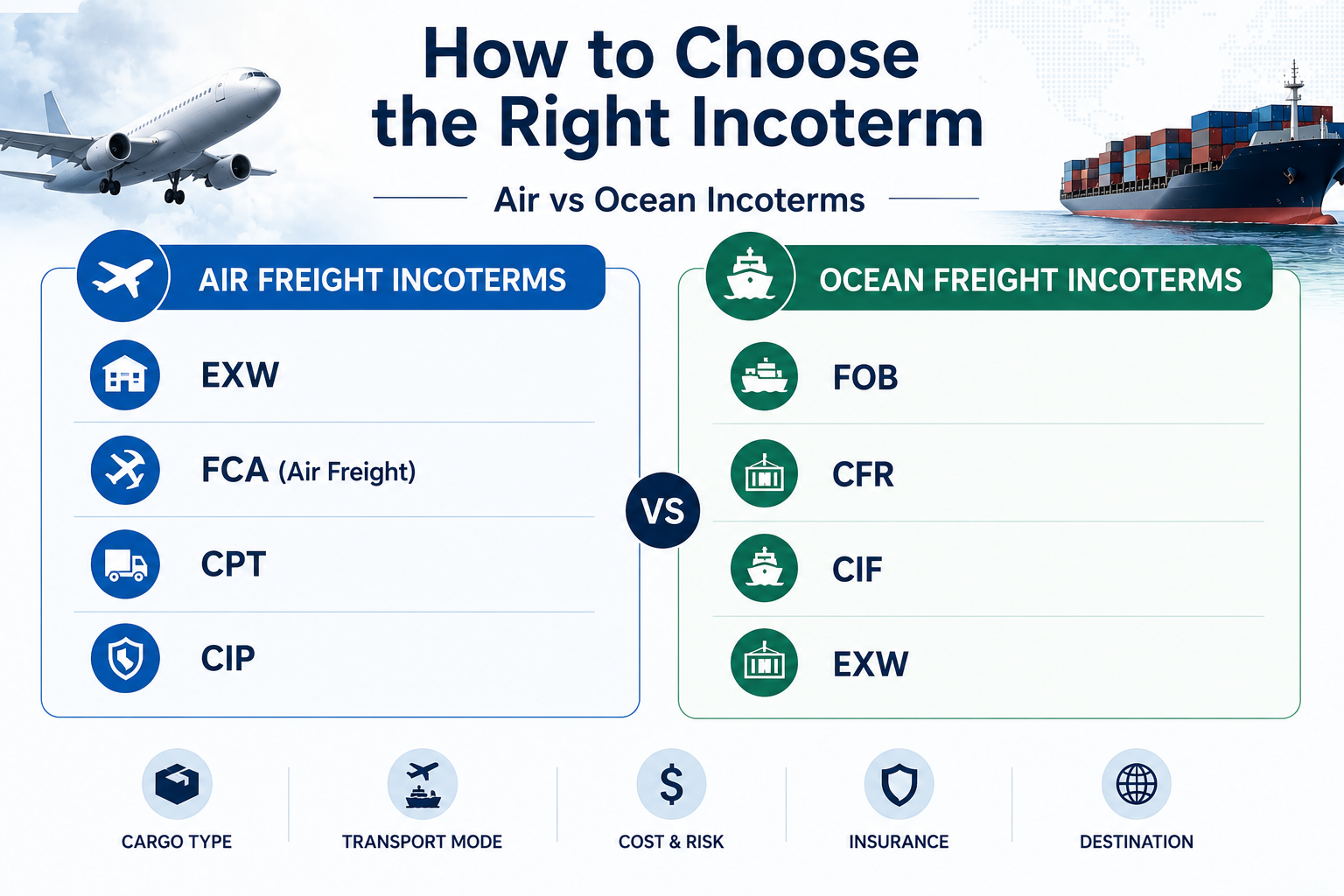
The right term depends on cargo type, transport mode, commercial leverage, insurance expectations, customs capability, and destination complexity. There is no single best rule for every shipment, but there are better choices for specific transport setups.
- For Air Freight
If the shipment moves by air, terms like FCA, CPT, CIP, DAP, DPU, and DDP are generally more appropriate than sea-only rules. FCA is especially useful when cargo is handed to the airline or freight forwarder at a terminal or origin point.
If insurance clarity is important, CIP may be preferable. If the seller wants to provide destination-led service without handling duties, DAP can be a good compromise.
- For Ocean Freight
If the shipment is moving by vessel, the decision depends on whether it is containerized cargo or traditional port-based marine cargo. For containerized cargo, FCA often works better than FOB because the seller usually hands over cargo before vessel loading, often at a terminal.
For bulk, breakbulk, or port-structured marine trade, FAS, FOB, CFR, and CIF may still be suitable depending on who arranges freight and insurance.
- For High-Value Cargo
Where goods are high-value, fragile, or commercially sensitive, the insurance structure matters. In such cases, CIP may provide stronger comfort than CPT because insurance is explicitly included by the seller.
- For Buyers Needing maximum simplicity
If a buyer wants a more turnkey structure and the seller can manage destination complexities, DDP may look attractive. However, it should be used only when the seller is confident in destination compliance, taxes, and local regulations.
Related Reading:- Complete Guide To Incoterms
Common mistakes to avoid
- One of the biggest mistakes is using FOB or CIF for air shipments. These are maritime rules and should not be used when cargo is moving by air.
- Another common error is treating risk transfer and cost payment as the same thing. Under many Incoterms, the party paying for main carriage is not necessarily the party carrying the risk for the full journey. CPT, CIP, CFR, and CIF are classic examples where cost and risk split at different points.
- Shippers also make mistakes by failing to specify the named place or port clearly. Incoterms work properly only when the delivery point is precise, because that point determines where obligation and risk shift.
- A further problem is choosing DDP casually without understanding tax, customs, and compliance exposure at destination. What looks commercially attractive can become operationally difficult if the seller lacks destination-country expertise.
Final takeaway
Understanding incoterms for air freight is essential because not all 11 rules apply equally across transport modes.
Seven rules can be used across air and ocean movements, while four are reserved strictly for maritime and inland waterway transport.
In most modern air cargo and containerized shipping scenarios, FCA, CPT, CIP, DAP, DPU, and DDP are more relevant than traditional vessel-loading terms.
For sea freight, FAS, FOB, CFR, and CIF still matter, but only when the shipment structure genuinely fits those maritime conditions.
The best decision comes from matching the Incoterm to the actual operational flow of the cargo, not simply using the most familiar trade term.
When chosen correctly, international commercial terms reduce ambiguity, clarify liability, and make both air and ocean freight transactions more predictable.


