




Do you ever wonder about how to palletize a shipment in order to arrive on time without any trouble at its destination? If so, then you are at the right place.
Here you will learn about how to choose the right pallet and how to meet pallet requirements for international shipments. At the end, you will be all set to handle your freight like a professional.
A pallet shipment isn't just faster to move, it's safer. According to OSHA Forklifts are involved in an estimated 95,000 workplace injuries and roughly 100 fatalities in the U.S. each year, and OSHA's powered industrial truck standard exists largely because of how loads are built and handled.
What Is Palletizing?
Palletizing is the process of arranging and securing goods on a pallet — a flat, portable platform made of wood, plastic, or metal — so the load can be moved as a single unit with a forklift or pallet jack, rather than handled piece by piece .
What does palletizing imply to your business?
It reduces broken boxes, quicker loading and easier handling during each of the stops in the supply chain. Workers may move an entire box instead of carrying individual boxes one by one. This saves time and reduces injuries.
Palletized shipments are organized in a way before moving them from the warehouse. Once the shipment has been palletized, it can be stored in the warehouse palletizing system, truck or container without re-packing.
.png)
Palletized vs. Non-Palletized Shipping: Which Is Right for You?
Not all shipments require a pallet. Knowing how to palletize is only beneficial when you know if it fits your freight. But how to choose? Let's see the pros and cons.
Palletized Shipping
Pros
- Faster loading and unloading
- Less product damage
- Better warehouse organization
- Lower labor costs
- Safer handling
- Easier customs inspection
- More consistent freight quotes
Cons
- Added weight and space from the pallet itself
- Upfront cost for pallets, wrap, corner boards and strapping
- Not ideal for very small or oddly shaped shipments
- Wood pallets crossing borders must meet ISPM-15 treatment rules
- Wasted container space if pallet dimensions don't match the container size
Non-Palletized (Loose) Shipping
Pros
- Lower upfront cost
- Better space efficiency for oddly shaped or very small items
- Can be cheaper for small, one-off shipments
- No ISPM-15 compliance step
Cons
- Slower loading and unloading
- Higher risk of product damage from shifting, crushing, or mishandling in transit
- Harder to inspect at customs
- More manual labor and a higher risk of workplace injury
- Less accurate weight/dimension tracking, which can lead to freight quote disputes
- Harder to stack and store efficiently in a warehouse
Quick takeaway: Loose cargo might be acceptable for only a few oddly shaped or small cargoes, but when it comes to several crates or shipping overseas, palletizing will always be the better option in terms of safety, efficiency and cost, especially for customs clearance.
Choosing the Right Pallet: Types, Styles & Sizes
In order to choose the right pallet for a smooth pallet shipment we need to think about.
Standard sizes
The ideal situation would involve palletizing a box that is 24” (length) x 18” (width) x 24” (height). The upper limit for a pallet’s height is 62” (if shipping by Air) and 88” (if shipping by Sea) whereas each individual pallet’s weight should not exceed 4,600 Lbs while moving.
You can stack four boxes with these dimensions in one layer,so this means that one standard pallet can accommodate a maximum of three layers of boxes with the aforementioned dimensions, with four boxes in each layer.
Even though we transport consignments in a variety of shapes and sizes, our objective is to ensure optimal utilization of storage space while loading shipments.
There's no single "standard" pallet worldwide. ISO 6780 specifies six different sizes of footprints that are being used worldwide, which include the sizes 1200 x 1000mm and 1100 x 1100mm prevalent in Europe and Asia, along with the size of 48” x 40” prevalent in North America and the Euro size of 1200 x 800mm prevalent in Europe.
Always verify the size of the pallet being used at the destination before loading your consignment.
Pallet styles
Here are some common styles:
- Block pallets: stronger, with forklift access from all four sides.
- Stringer pallets: Lighter and cheaper, can be accessed from 4 or 2 sides, depending on design.
- Double-face pallets: can be used on both top and bottom for extra durability.
Wood vs. plastic pallets
Wood pallets are cheap, available and can be easily repaired. Plastic pallets are expensive but are more durable, they don't attract moisture and are never fumigated for international shipping.
Plastic may save money over time if your goods need to cross borders often.
Inspecting a pallet before reuse
Before reusing any pallet check for these problems:
- Rusted, splintered or broken boards.
- Loose nails or fasteners.
- Signs of mold, pests, or moisture damage
- Uneven or sagging surfaces
Damaged pallets can collapse shipment in mid way, so it's important to check before to save extra time.
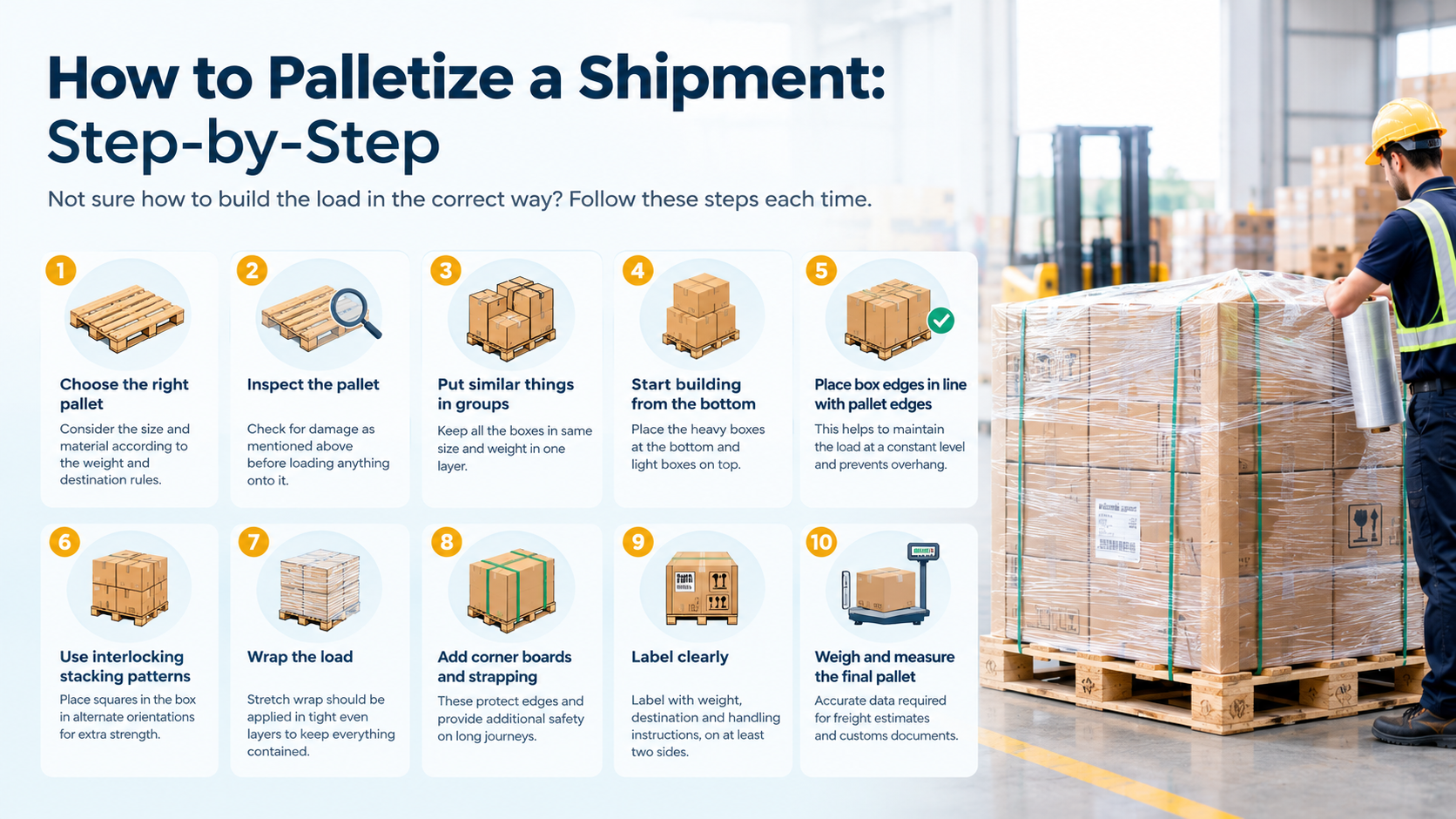
How to Palletize a Shipment: Step-by-Step
Not sure how to build the load in the correct way? Follow these steps each time.
- Choose the right pallet: Consider the size and material according to the weight and destination rules.
- Inspect the pallet: Check for damage as mentioned above before loading anything onto it.
- Put similar things in groups: Keep all the boxes in same size and weight in one layer.
- Start building from the bottom: Place the heavy boxes at the bottom and light boxes on top.
- Place box edges in line with pallet edges: This helps to maintain the load at a constant level and prevents overhang.
- Use interlocking stacking patterns: Place squares in the box in alternate orientations for extra strength.
- Wrap the load: Stretch wrap should be applied in tight even layers to keep everything contained.
- Add corner boards and strapping: These protect edges and provide additional safety on long journeys.
- Label clearly: Label with weight, destination and handling instructions, on at least two sides.
- Weigh and measure the final pallet: Accurate data required for freight estimates and customs documents.
By following these steps, any loose order becomes a secure and reliable pallet shipment for transport.
You can check our palletizing guide to know how and why to palletize the shipment
Loading Palletized Freight for Transport
The loading of your pallets is as important as the building of your pallets!
Dock loading basics
Position pallets to allow forklifts to move in/out without having to tighten their turns. To balance the weight, load heavier pallets on the floor or at the bottom
Forklift safety checklist
In the United States, any operator who operates a forklift for the purpose of lifting a palletized load needs to undergo training in accordance with the OSHA Powered Industrial Truck standard (29 CFR 1910.178), it is not an option.
- Check the weight if the forklift matches the pallet load.
- Lift forks level and held all the way under the pallet.
- Reduce speed and do not make sudden stops carrying loads.
- Do not let anyone walk under the lifted pallet.
Making pallets safely stackable in-trailer
Do not stack pallets unless the bottom layer can hold the weight of the top pallet layer. When stacking fragile items use pallet stacking frames. If the product requires space for ventilation, leave some space.
Pallet Requirements for International Shipments
It's here where many shippers get into trouble, so take a close look. They are more rigorous than domestic shipping regulations and missing one detail can hold your goods at the border.
ISPM-15 wood packaging rules, explained simply
ISPM-15 is an international standard on wood packaging. It does need raw wood pallets to be treated by heat or fumigation to kill pests before shipping into another country.
Treated pallets have a stamped mark. It is contained within a circle or oval. This stamp indicates the treatment and country code.
If this stamp is not found on your wood pallet, then your shipment may be refused entry, fumigated, or destroyed by customs officials upon arrival.
One of the most frequent causes of freight being stuck overseas is this stamp. Plastic pallets or certified and pre-stamped wood pallets are completely out of this risk.
How pallet dimensions interact with container space
There's no such thing as too many containers, and thus, the size of the container has a direct impact on the cost. A standard 40' container will hold approximately 20 euro pallets.
It fits with the same amount of standard pallets depending on stacking height. Wasted space is avoided by choosing the correct pallet size for the container. This reduces the cost of your units.
There are also mismatched pallet sizes which can cause gaps in the pallet that allow cargo to shift in transit.
This movement can damage goods and hamper the unloading of the goods at the destination port.
Documentation that must match the physical pallet
All the numbers on the paperwork should match exactly with the actual palletized cargo. This includes:
- Total pallet count
- Weight on pallet and ship weight
- Dimensions of each pallet
- Treatment certificates issued by ISPM-15, if necessary
- Commercial invoice and packing list details
A mismatch, such as if the pallets are one off, can also result in a manual customs inspection. That inspection may extend your delivery time.
Why forwarders like Sky2C check pallet compliance before it becomes a customs problem
This is where an experienced freight forwarder becomes priceless. At Sky2C compliance is verified before the freight is shipped from the warehouse, rather than after it is detected at a border.
This involves inspecting the ISPM-15 stamps. It implies matching paperwork to the real load. It also involves ensuring the size of the pallet is compatible with the shipping method.
Early detection of these problems translates to faster clearance through customs, less unexpected costs, and few delays to your pallet shipment.
This is the type of proactive check that differentiate between a reliable freight partner and a basic booking service.
How to Choose a Palletizing System (When You're Scaling Up)
With the increasing order volume, manual palletizing can be a delay in the shipping process.
Understanding how to choose a palletizing systems setup starts with your own operation. Don’t just look for the sticker price.
First ask these questions:
- How many different SKUs do we manage per day?
- What is the throughput we want to reach every day or hour?
- How much space do we have in the warehouse?
- What is the actual cost with maintenance that we can afford?
|
Factor |
Manual Palletizing |
Semi-Automated System |
Fully Automated Robotic System |
|
SKU variability |
Best for high variety, mixed sizes |
Handles moderate variety well |
Best for consistent, repeat SKUs |
|
Throughput needs |
Low to moderate volume |
Moderate to high volume |
High-volume, continuous operations |
|
Warehouse space |
Minimal space required |
Moderate footprint needed |
Larger footprint, but higher density output |
|
Budget |
Lowest upfront cost |
Mid-range investment |
Highest upfront cost, lower long-term labor cost |
Manual or semi-automated palletizing is typically more appropriate if the product mix is frequently changing.
Automation can be a quick return on investment if you're running high and steady volume with the same box sizes. It generates all pallet shipments faster and more consistently.
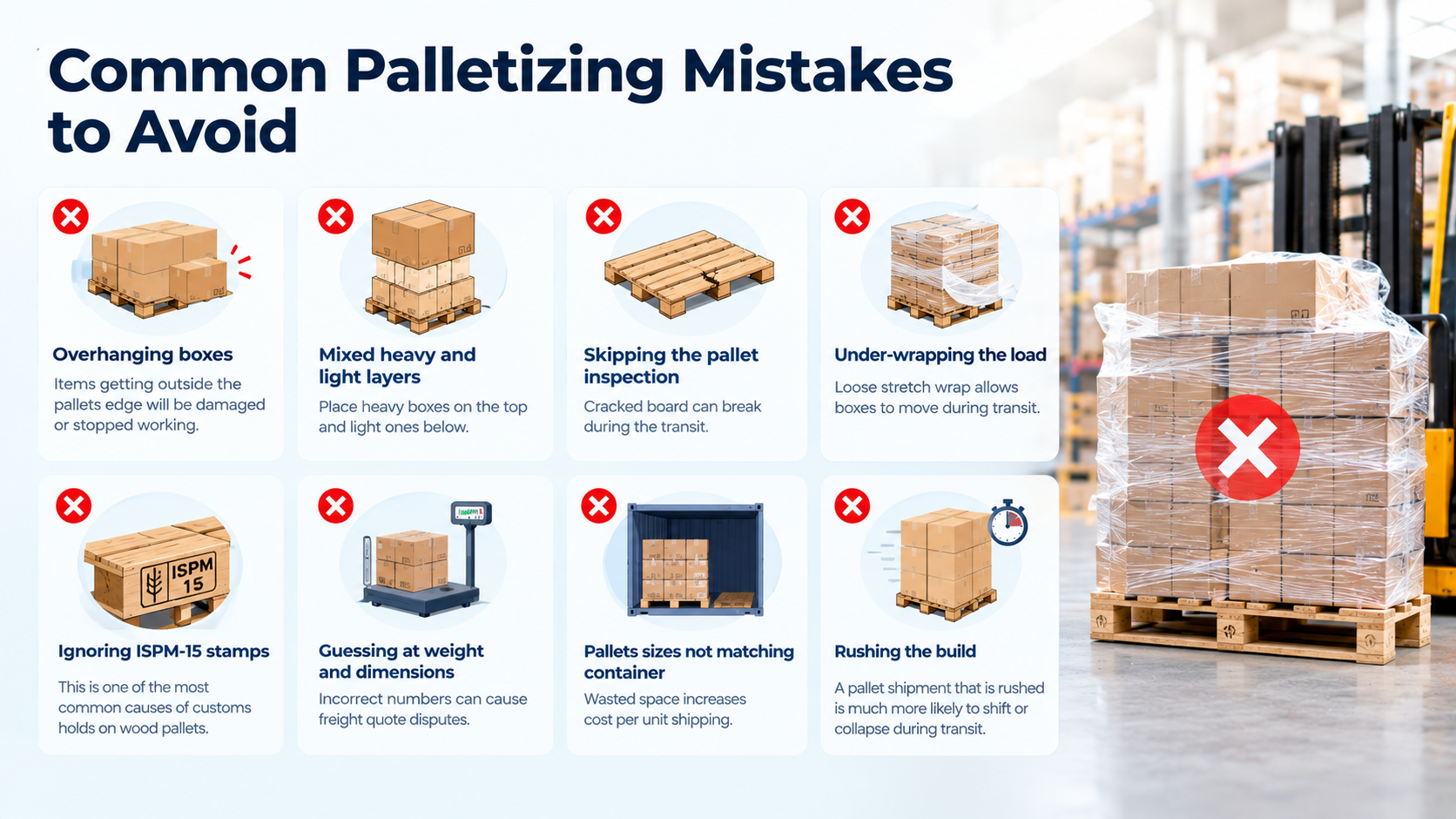
Common Palletizing Mistakes to Avoid
- Overhanging boxes — items getting outside the pallets edge will be damaged or stopped working.
- Mixed heavy and light layers — place heavy boxes on the top and light ones below.
- Skipping the pallet inspection — cracked board can break during the transit.
- Under-wrapping the load — loose stretch wrap allows boxes to move during transit.
- Ignoring ISPM-15 stamps — this is one of the most common causes of customs holds on wood pallets.
- Guessing at weight and dimensions — incorrect numbers can cause freight quote disputes.
- Pallets sizes not matching container — wasted space increases cost per unit shipping.
- Rushing the build — a pallet shipment that is rushed is much more likely to shift or collapse during transit.
Conclusion
A solid pallet shipment ensures that your products are safe, more efficient to handle and less likely to suffer from costly customs delays. Whether you're buying the right pallet material, or using the appropriate wood treatments to comply with ISPM-15 requirements, things count when your cargo is moving across borders.
Sky2C has the experience to take you through all these steps, ensuring pallet compliance and documentation before issues arise.
Maybe it's your first pallet. Maybe you're expanding an established business. An experienced freight forwarder can detect the problems in early stage and will save you time and money.
Ready to ship your next shipment with peace-of-mind? Contact Sky2C today for free freight quote and our team will take care of the details for you.
Frequently Asked Questions
Q1. How much weight can a standard pallet hold?
A standard wood pallet usually holds between 2,000 and 4,600 pounds, depending on its build and condition. Always check the pallet's rated capacity before loading, since overloading can cause it to crack or collapse.
Q2. Can I reuse pallets for international shipping?
Yes, as long as the pallet still carries a valid ISPM-15 stamp and shows no damage. If the stamp is missing, faded, or unreadable, customs may reject the shipment, so a fresh, certified pallet is the safer choice.
Q3. What is the difference between shrink wrap and stretch wrap?
Stretch wrap is stretched by hand or machine as it's applied, which creates tension that holds boxes tightly in place. Shrink wrap is heated after it's applied, so it shrinks around the load. Most palletizing uses stretch wrap because it's faster and doesn't need heat.
Q4. How many boxes fit on one pallet?
This depends on the size of your boxes and the height limit for your shipping method. As a rule, keep total pallet height under 60 inches, including the pallet itself, unless your carrier allows more.
Q5. Do I need a pallet for a small shipment?
Not always. If you're shipping just one or two boxes, palletizing may add unnecessary cost and space. Palletizing pays off once you're moving multiple boxes or a full case pack that benefits from forklift handling.
Q6. What happens if my pallet doesn't meet ISPM-15 rules?
Customs officials can hold, fumigate, or destroy the wood packaging on arrival, which delays your palletized shipment and adds unexpected fees. This is why checking compliance before departure, as Sky2C does, matters so much.
Q7. How long does it take to palletize a shipment?
A trained worker can build a standard pallet in 10 to 20 minutes, depending on the number of boxes and how carefully the load needs to be arranged. Automated systems can cut this time down significantly for high-volume operations.
Q8. Is plastic or wood better for international shipping?
Plastic pallets skip the ISPM-15 treatment requirement entirely, since they aren't made from raw wood, which simplifies customs clearance. Wood pallets cost less upfront but need proper heat treatment and a valid stamp for international shipping.


